
Pharmaceutical industry
A medicine carton carries more than a product name and an active ingredient: it also carries a unique identifier, a batch number and an expiry date, encoded in a Data Matrix that gets scanned at dispensing. Tubes, ampoules and rapid-test pouches are small and curved, yet the code on them has to stay readable — after sterilisation and after a wipe-down with disinfectant. On top of that, the secondary packaging has to record which unit went into which case and onto which pallet.
Labelling tubes and tube racks
Sample and reagent tubes get their label straight off the printhead: a print & apply unit prints the batch number and the code, then rolls the label onto the cylindrical surface. The tube diameter is small and the label is narrow, so the code only stays readable if the application is straight and free of wrinkles. Tube racks are marked on the same principle, fully automatically — from positioning the rack to applying the label, without a hand touching either.
Labelling rapid-test pouches on the packaging line
Rapid-test cassettes are sealed into foil pouches, and the pouch carries the batch number, the expiry date and the code. Here the print module is built into the packaging machine itself, and the applicator places the label right after sealing — no separate labeller, no separate operator. The difficulty is the integration: the module has to fit inside the machine and keep the line’s pace, while the foil pouch is anything but a rigid backing.
Serialisation and aggregation
Every prescription medicine carton receives a unique identifier in a GS1 DataMatrix, alongside the batch number and the expiry date. The identifier has to be generated, recorded and tied to the print job — and the cases and pallets record which unit ended up where, which is aggregation. The label management system therefore works from ERP master data, and every change to a label template passes through an approval workflow, so that only released versions reach production.
Codes that stay readable after disinfectant wipes and sterilisation
A medicine carton spends months in a warehouse and on a pharmacy shelf, while tubes and rapid-test pouches are wiped down in the middle of work — with ethanol, with isopropyl alcohol. The print has to take it: the code on the carton is scanned at dispensing, the one on the tube or the pouch at the point of use. A resin ribbon gives that resistance, and it needs a synthetic label material beside it — PET, polyimide or vinyl — because on paper the print smears. Where the label also goes through steam sterilisation, heat resistance narrows the field: there PET and polyimide are what remain.
Verification at dispensing, and patient wristbands
A medicine label is not only read, it is scanned: at dispensing, that check ties the preparation to the person it was meant for. The same logic continues on the patient wristband, which carries the identifier in machine-readable form. In both cases the question is how long the print stays readable — a wristband is rubbed and gets wet while it is worn, and the print has to hold out.
Applicable regulations
In many cases the content and form of the marking is set by law — worth clarifying at the start of the project.
- EU FMD (2011/62/EU)
- The Falsified Medicines Directive requires prescription medicine packs to carry a unique identifier and an anti-tampering device, and the identifier to be verified when the pack is dispensed.
- GS1 DataMatrix
- The unique identifier is carried in a GS1 DataMatrix, which holds the product code, serial number, batch number and expiry date under standard application identifiers.
Recommended machines
Not a complete list, but what suits the most common tasks in this industry.

At 600 dpi a single code module can be a few tenths of a millimetre and its edges still come out sharp — which is how the code fits the small labels on tubes and ampoules.

The centre-aligned media guide version, for narrow tube labels where only precise web guiding gives a straight print.
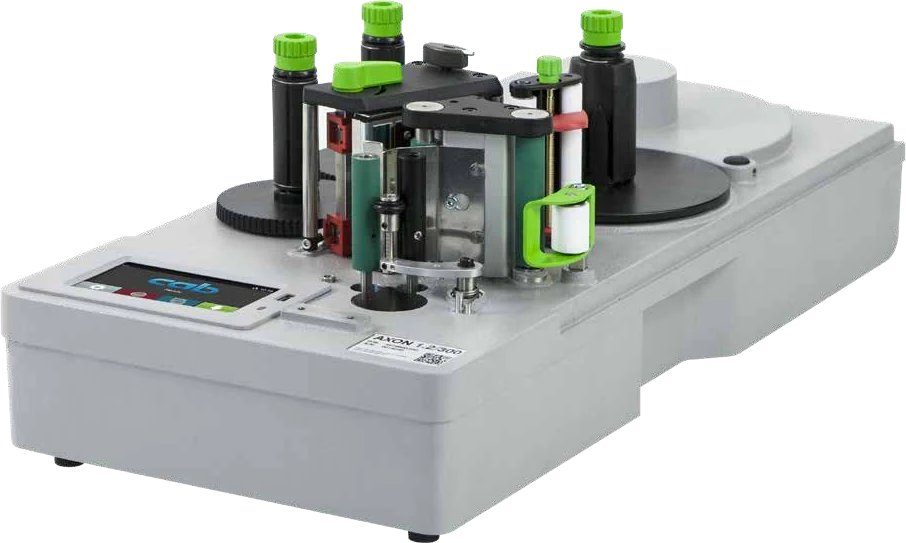
A benchtop labeller developed specifically for tubes and vials: it prints and labels a vertically inserted tube in under two seconds, and the tube can be filled right in the retainer.
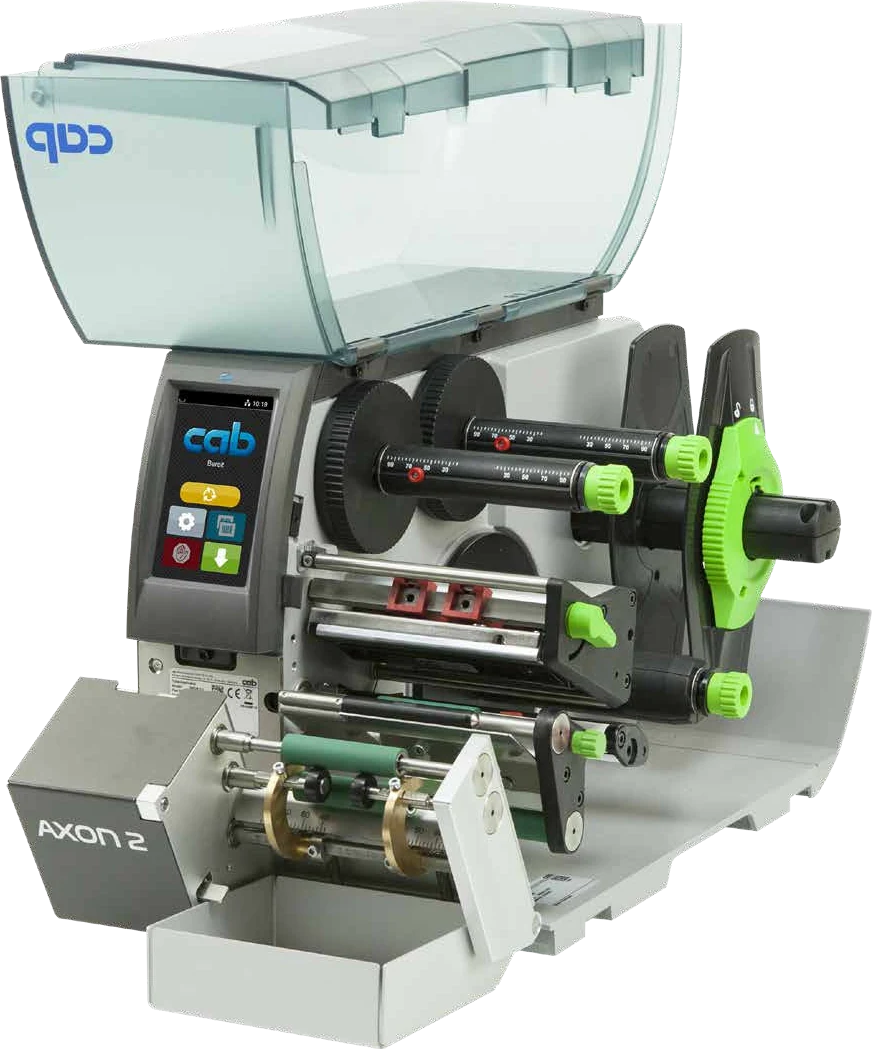
A tube applicator developed for tubes and vials on the SQUIX 4 MP printer: it labels horizontally inserted tubes, capped ones too, and collects the finished tubes in a tray.

A print & apply unit that prints and applies tube and rack labels in a single operation.

A print module that builds into the packaging machine sealing the rapid-test pouches, so no separate labeller is needed.

A modular labelling head for tight spots on the packaging line: the unwinder and rewinder can be mounted separately from the base unit, and the head can be installed vertically or horizontally.

A label dispenser for the manual workstation: it peels each label off the liner and presents it for the next pick, for ampoules and smaller batches.

The label management system that generates and prints the unique identifiers, with an approval workflow and a link to the ERP.

Wax, wax-resin and resin ribbons from one range, for paper and synthetic labels alike: the medicine labels take the resin grade, while wax is enough for the paper labels on the cases.

The same three ribbon families — wax, wax-resin, resin — for near-edge printers as well as flat-head ones. With two manufacturers in the range, the width a job needs can be sourced in the grade it needs.

A general-purpose 2D imager for the dispensing point: it reads Data Matrix codes in any orientation, including poorly printed or damaged codes and codes shown on a phone screen.
Related guides
Not finding your own task?
Tell us what needs marking, in what volume and under what conditions — and we will suggest a solution.
Contact us